
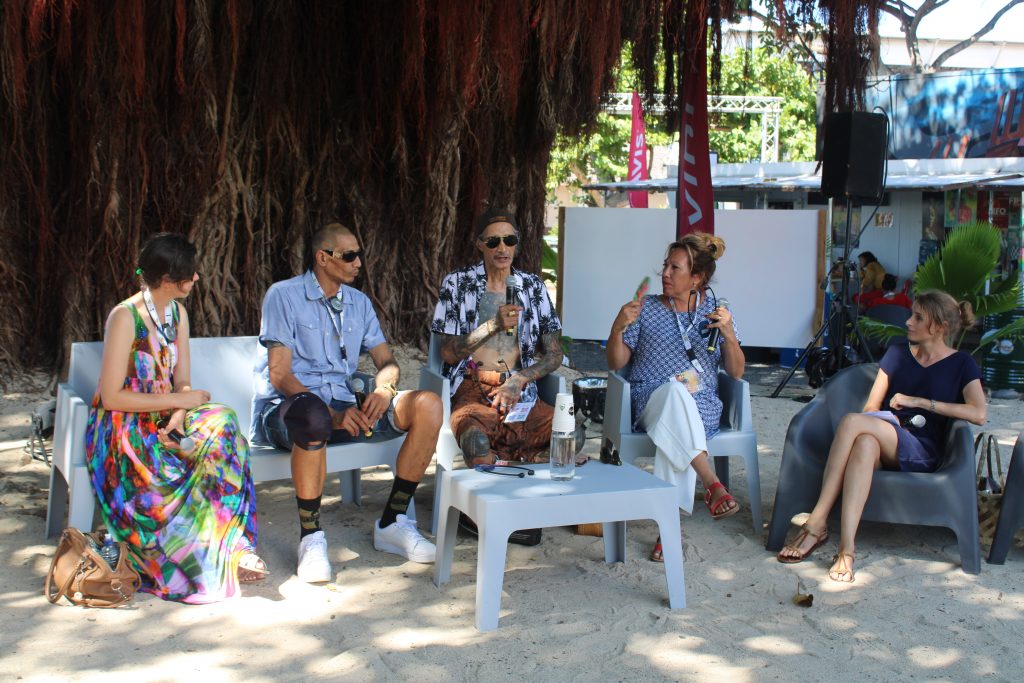
Fa’amoana John Luafutu and his son Matthias Luafutu are the protagonists of the documentary, A boy called Piano, directed by Nina Nawalowalo, in competition at FIFO. The entire film crew is present in Tahiti, coming to meet the public and the inmates of Tahiti, telling their story.
Some piano notes, bubbles of air, dark water, a child immersed in the sea surround his knees with his arms. One would think a baby in its mother’s womb. «Innocence. We all start out in innocence,» says Fa’amoana John Luafutu. The piano was his mother’s first love. After she got pregnant, she stopped playing and calls her son «Piano,» her second love. The whole family leaves the Samoan Islands for New Zealand, hoping for a better life for their children, dreaming that they will become doctors, lawyers… But here Fa’amoana doesn’t speak English and he gets lost in this school where he is mocked. They even take away his name, preferring to call him John, easier to pronounce. So the child goes to the bush school. It’s better to be in the park. Arrested by the police, he is taken to the children’s court and placed in a rehabilitation home. Thus begins the hell… At 13 years old, he ends up at Kohitere home. « I learned a lot about things that weren’t very pleasant,» he recounts as he returns to the scene, 48 years later. It’s really very strange to be there. Many of the guys with me at that time are dead. « The children are mistreated there, locked in the isolation ward, a cell of a few meters with a bucket, at the slightest deviation. » The lights and shadows at the window indicated the times of the day. Those who leave this place usually end up in prison a few years later. Gangs, violence… « We leave these shelters angry. I was filled with hatred. It just gave me tons of pent-up anger. You become a burned out person. »
While in prison, he came across a book by Albert Wendt, a Samoan poet and writer: Sounds for the Return Home. It’s an electroshock. He starts to correspond with the writer who encourages him to write his own story. With this book, A boy named Broke, Fa’amoana John Luafutu tries to understand his life. Especially since his eldest son follows in his footsteps: prison. At the time, many have the same story: the father who went to a rehabilitation center and the son who goes to prison. Matthias Luafutu is saved by comedy. He does theater in prison and becomes an actor. The two men rise again, one thanks to writing and music, and the other thanks to theater and cinema. «It’s only now that I can look at my past,» explains Matthias. «I know what it means to stand up not only for the future but also for the past.» The two protagonists of this impressive documentary are present at the FIFO in Tahiti and spoke about their story to the general public as well as to the detention centers of Nuutania and Tatutu. “Yesterday we went to the Tahiti prison; we wanted to show the film to the inmates. I saw a guy, the same age as me, and his son, both in prison, they were crying. It was moving to see these tough guys cry because they identified with our family. I advised them to write their story, to look at the present and to do something positive for their family. It is an honor to bring this film to prisons to encourage social change,” says Fa’amoana John Luafutu.
Today, through their testimony, the two men are fighting against «this industry»: «The government wants more concrete, more prisons, but we have to put an end to this industry because it is an industry!» Heard by the Royal Commission on Abuse in Childcare, we see Fa’amoana John Luafutu testify about the abuse and the whole country is trying to face its past. «This is really the story of many children in Polynesia, it’s the reality of many people,« says Nina Nawalowalo, the director, who has worked with the Luafutu family for many years. Together, they wrote and performed a play, then a radio play before making a documentary that was presented this year in competition at FIFO. »I think it’s very universal. It’s interesting to see that in documentaries, whether in Canada, Finland, Australia, something is hidden but it exists.« The most important thing is to tell the truth, to acknowledge the impact of these things and that they are becoming a generational problem. We need to bring these things to the surface in order to try to heal them. Matthias Luafutu adds that indeed, this pain has been »inherited.« But it was enough of a single thing: “My father transformed his life and encouraged me to change mine. I did it early enough to save my son from the same path.”.
My children don’t have the same difficulties; we’re better off now. I feel blessed; I’m very lucky to have a career in cinema and theater; it has transformed my life.»
The documentary ends with the words of Fa’amoana John Luafutu: «The story of thousands of children must be heard. We must face our history. Truth must set us free.»
Lucie Rabréaud – FIFO
 French
 English