
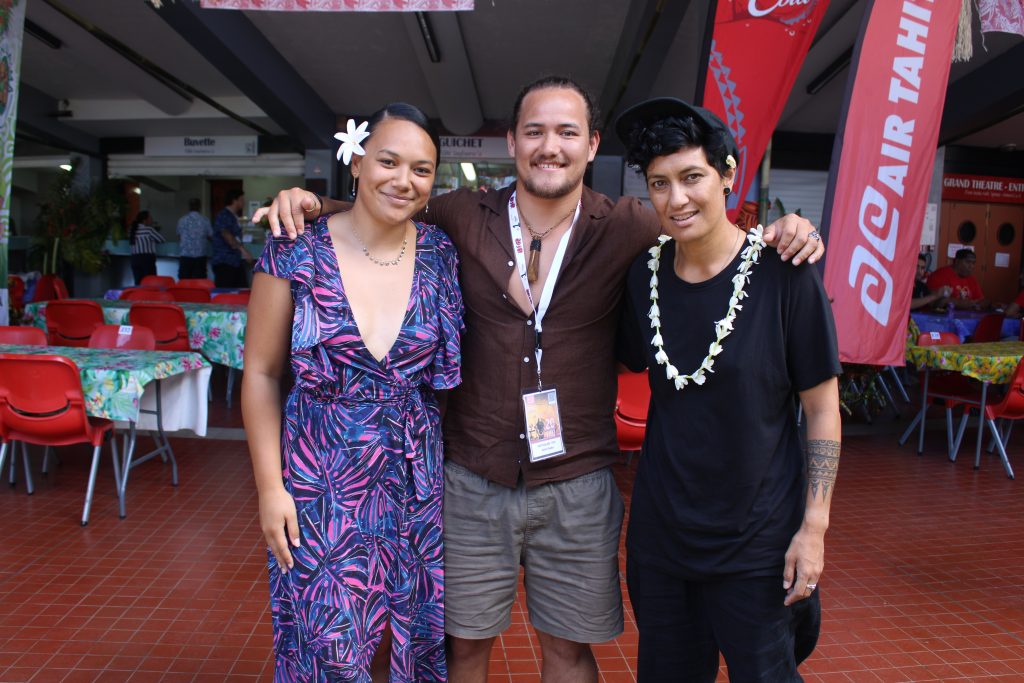
Kahu Kaiha made a short film, in which he also plays a role, which was presented at Fifo. Find where I belong tells the story of two homeless people in the streets of New Zealand and the dream of one of them to return home to the Marquesas Islands.
How did you come to realize it?
By accident! In 2018, I left Polynesia to study acting and I have been working as an actor in New Zealand for four years now. I am represented by an agent there. Last year, I noticed a lack of roles for Polynesians, especially those from French Polynesia, and I thought I would start making films because I have a talent for writing and I have a lot of experience. So I wrote a script, found a producer and made it.
Where does the story of this short film come from?
I have always had the desire to express and play characters from minority groups. For my personal story, and that of my parents who were homeless when they arrived in Tahiti, I wanted to start my career with an idea that was close to my heart. That’s how I started researching for a feature film and then decided to start with a short film to see if people liked the story and if the concept worked.
Will this short film then become a feature film?
I think... If I'm still young enough to do it and if I find producers who are willing to finance it.
What was the message of the film?
I wanted to talk about the identity quest and the quest for home. I am part of the young people who leave French Polynesia to find a life and who sacrifice leaving their island by leaving their «home» behind. What I notice when I am abroad is that the Polynesians want to find their «home». The only way to do that is to hang out with people who come from your island. The topic came up because many members of my family have gone to the army; they come back from time to time, sometimes in a coffin. This quest for self… Is it really worth leaving your island to fulfill other people’s dreams?
For you personally, was it worth the cost?
It was worth the cost of leaving my island to have a different perspective on my island and French Polynesia. It is important for me to leave to answer this question: «What is my purpose?» It wasn’t about leaving to go somewhere else, but to go to train and return to French Polynesia to work and really get interested in the problems of our society.
Do you plan to return to French Polynesia soon?
I’m not going to move in there to live, but I’ll come back to tell our story to the world. I’m coming back to work here. And I’ll have my people working here. It’s already started! I have many great projects in mind. There will be several works: long documentaries, fiction.
This short film is also the story of a collaboration with a collective and in particular with Nikki Si’ulepa?
Nikki is part of the New Zealand collective PISA (Pacific Islanders Screen Artists) which brings together people who make film, comedy… My girlfriend Carrisse Uta’i, the producer of the short film, and I are part of this collective. And we had her «mentorship»; she guided us through the production and the filming. She is a very great filmmaker in New Zealand. It wouldn’t have been possible to make this short film without this collective, which promotes the learning of this art among young indigenous people, and that is what helped us find our path in this career.
Are you proud to see the short film at the Fifo?
It’s a source of pride because this short film was originally intended for French Polynesia. I’m proud of the enthusiasm surrounding the film.
Interviews conducted by Lucie Rabréaud – FIFO
In context:
That the islanders tell their stories
Nikki Si’ulepa, a Samoan who is part of the PISA (Pacific Islanders Screen Artists) collective, was the «spiritual adviser» as she likes to say about this short film. For Kahu Kaiha, the director and Carrisse Uta’i, the producer, this short film was a first and without the collective they would not have been able to train themselves. «I met them two years earlier,» says Nikki Si’ulepa. «They have a lot of energy, a real ambition to tell their own story in their own way. I asked them to join the collective, which they immediately did and they were able to attend the workshops to train themselves. They gave me a lot of trouble! But I couldn’t say no. It’s a pride to see this short film presented at Fifo. They did a great job.» Carrisse Uta’i, a Samoan, admits that producing wasn’t her dream but she was chosen. «I am proud to have collaborated with someone from the Marquises.» For me, it’s important to produce content and to keep the power to speak about our stories. » Nikki Si’ulepa agrees and adds: « Many films have been made about us but they don’t have the same perspectives as ours. »
Lucie Rabréaud / FIFO
 French
 English