
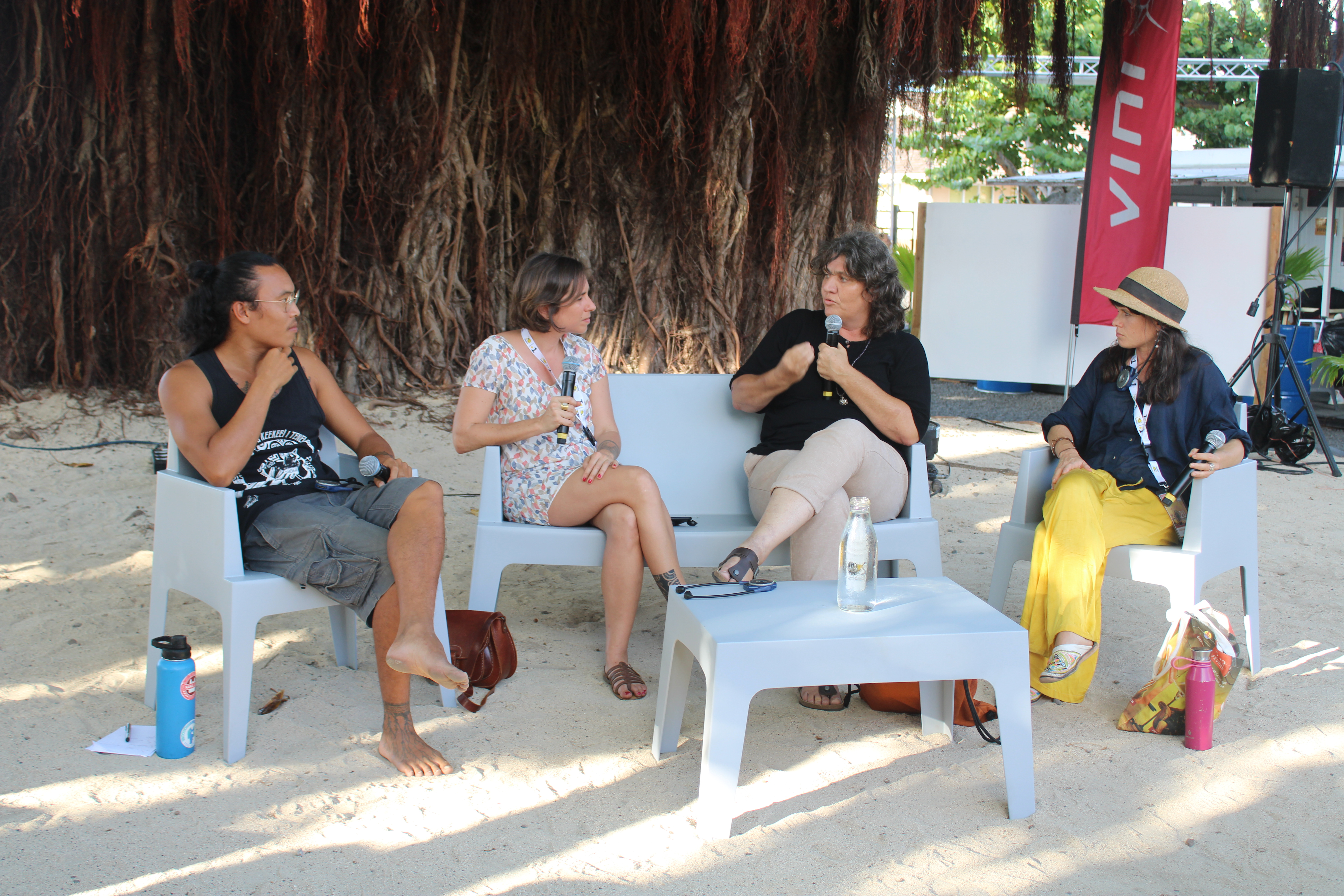
A roundtable and an evening were organized on Wednesday evening on one of the festival’s strong themes, which is central to many documentaries: the human being and its environment. Two filmmakers, Briar March and Christine Della-Maggiora, spoke about their own work and experience.
Briar March, director, Christine Della-Maggiora, director and jury member, and Jason Man, environmental activist, were the guests of a roundtable organized on Wednesday at the Fifo. The environment, a strong theme of the festival, often appears in the documentaries presented. But does that make a difference? Yes, clearly for the three people. When Briar March makes There once was an islan – Te Henua e Noho, it is 2006 and the rising waters are not yet known when on this small island of Taku, 250 km from Papua New Guinea, it is a reality. The documentary received the Grand Prix of the Fifo in 2010 and since then the director has noticed that the subject is now common, even though solutions have not yet been found… Filming the inhabitants of this small island was like an allegory about how the world would respond to climate change. At the time, I was told that it wasn’t due to climate change but today there is more acceptance. I saw a change. But last week there were floods in Auckland. It’s crazy! And it’s frustrating to see what’s happening. For Christine Della-Maggiora, her film Le salaire des profondeurs, about these Fijian fishermen who die or remain severely disabled after fishing accidents, managed to influence the Fijian government which took measures to ban this terribly dangerous deep-sea fishing. The effects were therefore immediate.
It is by showing reality that female filmmakers manage to awaken consciences and sometimes to make things happen. «As a filmmaker, I show their world, a place where there is usually no camera. It is a form of power and a form of activism. I appreciate the dialogue and the way films provoke discussion. It is a great value for us that Fifo brings these films to the islands, to schools…,» explains Briar March. «When we have convinced or touched a person, then it is won!» says Christine Della-Maggiora, who with her partner Dominique Roberjot is trying to put the living into the center by, for example, having an iguana speak in a film, fighting for the protection of sea otters, «making films more organic.» For Jason Man, it is obviously the solution: to reach people’s hearts. «Emotion can trigger awakening. Actions are necessary, but we also need to tell stories.» «Briar March doesn't hide his despair over a situation that isn't evolving in the right direction and now wants to tell positive stories, »where there is success.« »I like the idea of partnering with associations so that they can use our documentaries to find practical solutions." Although Christine Della-Maggiora was an activist before becoming a filmmaker, Briar March went the opposite route, first as a filmmaker and then as an activist. Jason Man plans to remain an activist while hoping that filmmakers will continue to draw public and government attention to these issues.
Interview :
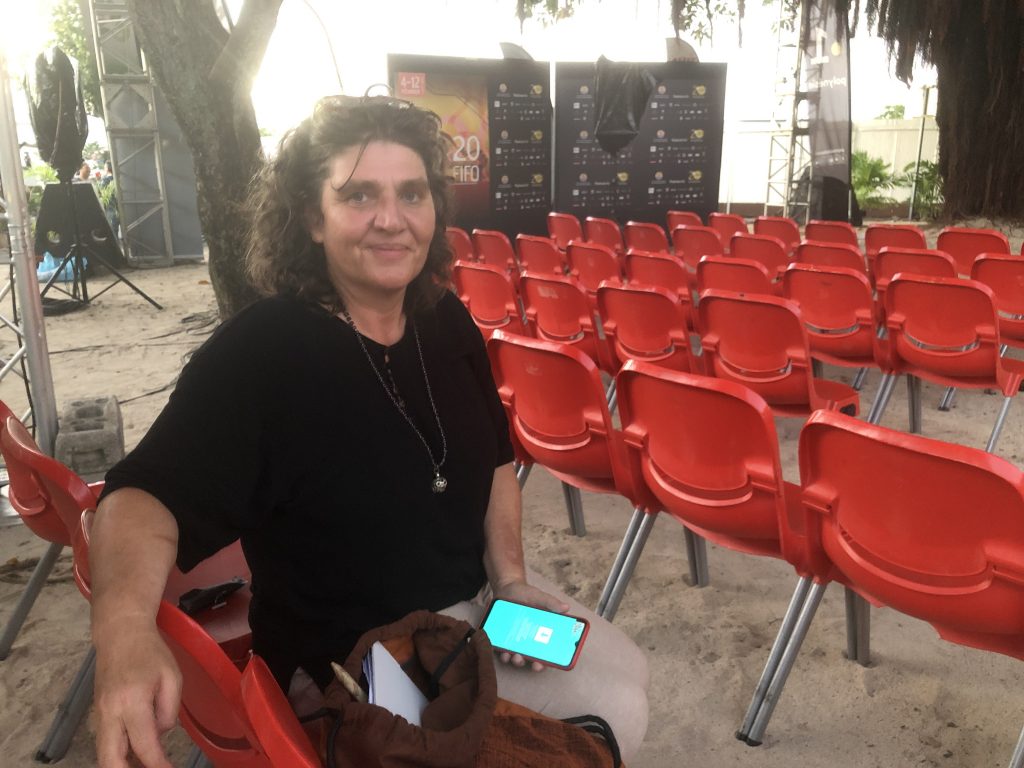
Christine Della-Maggiora, director and member of the jury
« Fifo is a platform for meeting people»
You were an activist first before becoming a filmmaker; what was your journey like?
I grew up in the northern districts of Marseille, at 10e I lived on the second floor of a tower and very quickly I realized that in the environment in which I lived there were few opportunities, so as soon as I could, I took off. I lived in concrete and my fantasy was nature, the forest. I did a PhD in social anthropology and I focused on what was called the first peoples at the time. I worked in Australia with the Aborigines, I did a thesis on the impact of tourism on the Aboriginal cultures. I went back to the communities and became an activist, I fought for everything that related to land rights, the impact of colonization… It shaped me.
At that time, you were therefore a militant?
Yes, I go to the United Nations, I support Aboriginal activists, I’m all in! Once I finished my thesis, I was offered a position as a research teacher at the University of Toulouse, but I couldn’t stay locked in a room when the world is moving forward. The only way to continue was to go out into the field. I needed to find a job that suited my aspirations. The obvious choice was the documentary film.
How did you become a director?
I first wanted to become a writer, so I moved to Australia, then to the Solomon Islands, and ended up in New Caledonia where I now live. I met Dominique Roberjot, who co-directs and co-writes the films with me. She was a photographer and I started taking photos. At the time, we were on the island of Maré and it all started at a nakamal party where the people from Maré told us that they couldn’t travel and share their culture. Their dream was to meet other peoples. We then went on a world tour in the same latitude as Maré (21), meeting indigenous peoples with an itinerant exhibition that we brought back to the island. But we realized that there were a lot of stories… Photography wasn’t enough, so we formed a group to become documentarists.
What were your first films?
In the first one, we made all the mistakes that needed to be made! And then the second one was filmed in Paraguay, with a people who had just left the forest, forced to abandon their traditional way of life because of the oil companies. This film was bought by Arte and we continued to travel and train. Sometimes the production was difficult because our films were controversial and a bit disturbing for the networks. So we decided to set up our own company, Latitude 21.
What are the themes of your films?
The first ones were very committed to the environment and human rights; then we moved on to social issues, trying to make New Caledonia known in Oceania. It was here that the Fifo allowed us to broaden our horizons. We presented several films at the festival.
What does the Fifo represent for you?
It’s a dating platform. Fifo allows Oceania people to discuss everything related to the region. These are different stories, but they resonate in the islands. This year, it’s a real honor to be a member of the jury; we’re among professionals; we’re talking about the documentary, its objectives, its importance, its writing, the content, the form; it’s very interesting. The exchanges are very rich. Among professionals, we understand each other and at the same time, we learn a lot. Someone from Australia doesn’t have the same perspective as someone from New Caledonia… It’s a very beautiful experience.
Is it difficult to choose just one documentary for the grand prize?
Yes, of course, but there are several of us and this will be a long discussion. As Marie-Hélène Villierme said, we won’t talk much, but we will talk for a long time.
Are these precise criteria that allow us to choose the award-winning documentaries, or does it come from the heart?
It is the international festival of ocean documentary film; there are three key words: documentary, international and oceanic. What is a documentary? Does it talk about Oceania? Can it carry the message beyond our small islands? We also have a particular attachment to how the background is conveyed through the form to be as impactful as possible. We discuss how to successfully reach people on a topic and how a film achieves its goal because it has been written and structured in a certain way.
What are your plans?
We have three major projects. The first is called Femmes kanak, women of influence around the history of the Kanak women of New Caledonia and especially of this new generation that for 10 to 15 years has been reaching high-level positions and taking a place in society that they never had; the second is with Wallis-et-Futuna that will trace the colonization of Oceania from Taiwan, through linguistics and the latest technologies that support the discoveries of linguists; the third will concern the geopolitical impact of China in the Pacific.
Article written and propositions collected by Lucie Rabréaud – FIFO
 French
 English