
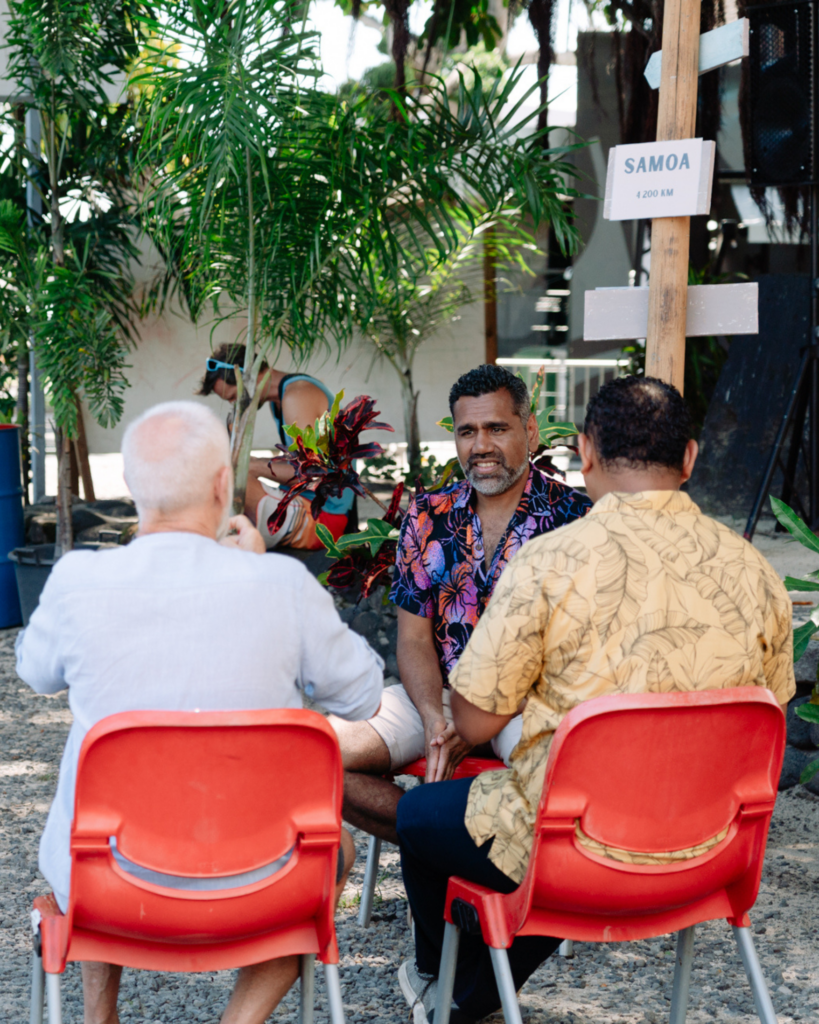
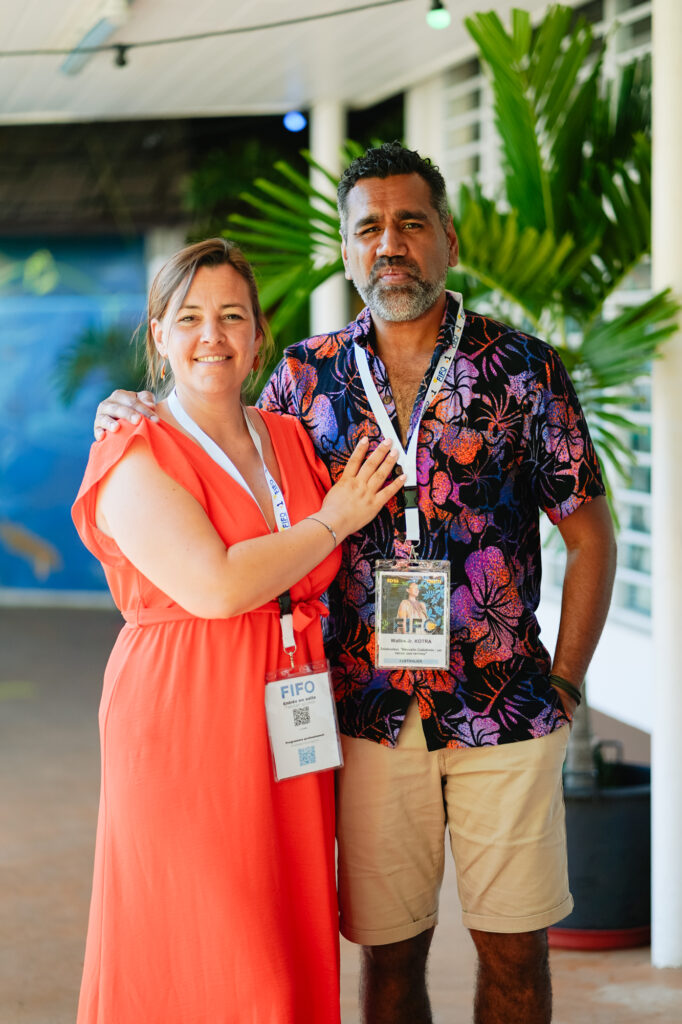
Wallès Jr. Kotra, deaf journalist for France Télévisions, presents his film “New Caledonia: a return to the roots”, for the 23rd edition of FIFO. He experiences the festival alongside his father, Wallès Kotra, co-founder of the festival, for the first time.
16,740 km is the distance that separates a deaf child from his family, considered too different in an island society and deeply oral.
Wallès Jr. does not forget where he comes from. A child of New Caledonia, he was born with a difference that he transformed into strength. The day his cousin told him “that as a Kanak with white people, he was learning a lot”, he understood that in the same way, being deaf among the hearing allowed him to discover, learn and create differently.
He experiences a particular childhood, far from the Oceanian sun… and his family. A major decision undertaken by his parents, to allow him to benefit from an adapted schooling. A brutal change with the long journey, the cold, the winter clothes, the fog, the dead leaves… «Everything was new for the child I was». On his way, he meets deaf professionals, teachers, educators and facilitators who have become his models.
School was his moral support, he felt included: “I had the feeling of being in my place, of being able to exchange freely and to live a normal childhood.” In his time, they worked at the couriers, so to communicate with his parents you had to be patient. “Reading them made me feel good, I even remember that my mother sometimes sent faxes to the school, to the director’s office,” he recalls. When he thinks about it, it almost makes him laugh: time, distance and waiting, but these exchanges have strengthened their bond.
“It’s not easy when you’re deaf”
Finding one’s place in an oral society, where speech is intimately linked to the land, is like not knowing your language among those who speak it. In an island environment, access is not always easy. The word being attached to customs, giving a place to those who are different still remains difficult. Wallès Jr. hasn’t totally found his place but he has built it permanently. Strongly attached to his culture, he has always greeted these moments in his own way, observing through looks and gestures, seeking to understand how the links between families and clans are built by words. He continues to move forward again with doubts but never without feeling lost: “Today, I know that my place exists, otherwise, but fully.”
Far from the eyes but close to the heart
Family ties remained strong, estrangement never erased attachment. The Kotra family rhymes with respect and trust marked by a history of important choices: “We have grown differently, but we remain deeply connected.” As a child, he didn’t really understand why he was so far away. Over time, he understood the act of love from his parents and the responsibilities undertaken for their son’s future: “Today, I am grateful to them for this courage.”
Today, Wallès Jr. participates in the FIFO alongside his father, who is the co-founder of this festival bringing together the voices of Oceania. After having followed the FIFO from afar for a long time, he is happy to be part of it and even more happy to know that the festival opens its doors to sign language. “I often told my father that I could bring my experience, especially on issues of accessibility and sign language,” says Wallès Jr. Father and son now share the same adventure, it is with great emotion that he comes to share his message: “accessibility is not a luxury, it is an essential condition for living together.” Deaf people from the Pacific also have a language, a culture and a place in island societies.
Pass the info by the signs
After obtaining his baccalaureate, Wallès Jr. focuses on training as a specialized educator without really recognizing himself in it. Without hesitation, he will finally turn to journalism like his father. He started for the media Websourd, a bilingual medium in French and sign language. Curious and eager to tell stories, he finally finds his domain: the deaf community watched him, followed him, and trusted him.
In his career, he meets Michel, a deaf man who became tetraplegic at 60 years old and expressed the desire to die. Faithful to Websourd, he accepted without hesitation that Wallès Jr. would make a film about him on the condition that it be a documentary for the Eye and the Hand. That’s how his “job” as a director began: “Michel’s Last Journey”, thus became his first documentary film.
Today, Wallès Jr. continues to convey messages for a more just place for the deaf community. “In 2025, a deaf Kanak friend told me that another deaf Kanak was coming to France. Some thought it was a vacation. In reality, he was coming to look after his nieces at the request of his sister. A simple and family gesture and yet, it made some smile… Me, no. He was 40 years old, with responsibilities, a place,” explains the man. He wants to change this perspective. For him, including deaf people is not only translating, but recognizing a language, a culture and a way of being in the world. «The more inclusive a society is, the richer it is.»
His biggest dream is to continue telling stories giving a full and complete place to deaf people and minorities. His film, “New Caledonia: a return to the roots,” is a tribute to this community still too much sidelined but especially an ode to its difference that makes its strength.
Credits: Jenny Hunter – FIFO Tahiti
Photo: Studio Marama – FIFO Tahiti
 French